
Blog | Emergency Roof Repair
What to Expect From 24-Hour Emergency Roof Repair in NJ
By Charles Kearns | Owner, Quality Roof Pros | Brick Township NJ | ~8 min read
When you call us for 24-hour emergency roof repair in NJ at (732) 770-3867, the call goes straight through to someone on the crew - no answering service, no wait. Within 5 minutes we know your address, what's happening on the roof, and whether conditions are safe to climb right now. Most active-storm calls become same-night tarping when wind drops to safe-climb levels (under 25 mph sustained). Sometimes we tarp at 11 PM. Sometimes we wait until 5 AM when the front passes. Either way, we keep you informed by text the whole time. Permanent repair gets scheduled for the next workable weather window. This guide walks through the dispatch flow, what we bring on the truck, how tarping decisions get made, and what insurance documentation we provide.
Pricing disclaimer: Any prices, ranges, or cost estimates referenced on this site are general guidance only and may vary based on roof size, pitch, materials, access, and current market conditions. They are not a quote or a guarantee of price. For an accurate written estimate, call (732) 770-3867 or request a free inspection.
What Counts as a Roof Emergency
Roof emergencies are situations where waiting until business hours costs more than calling now. Three conditions almost always qualify.
Active water entering the home during rain. Damage clock is running. Drywall, insulation, framing, personal property all on the line.
Tree, branch, or storm debris on the roof. The shingle envelope is broken. Once it rains, water gets in. We tarp before that happens.
Significant wind damage with shingles missing or lifted. Even if it's not raining yet, the next gust makes the damage worse. Tarp first, repair later.
Things that aren't emergencies: a stain on the ceiling that's been there for weeks, a few missing shingles on a calm day, a slow drip during a rare storm. Those get scheduled for next-day or business-hour service. We tell you which category you're in when you call. For non-emergency context, see our roof leak repair guide on when to call vs wait.
How the Dispatch Call Works
You call (732) 770-3867. Day or night, the line rings through to whoever's on emergency rotation that night. No answering service, no "we'll call you back tomorrow."
We ask 4 quick questions: address, what's happening on the roof, what's happening inside the house, and whether you're safe.
We assess weather and ETA. Active wind over 25 mph sustained means we wait until it drops. Lightning means we wait until the front passes.
We text you the dispatch ETA. You'll know within 10 minutes of the call whether the crew is rolling now or waiting for safe conditions.
What We Bring on the Truck
- Heavy-duty tarps sized 20x30, 30x50, and 40x60. Weight-rated for wind.
- Cap nails and 1x4 furring strips to anchor the tarp without damaging shingles.
- Replacement shingles in common architectural colors for emergency patch work.
- Pipe boots, flashing, and roofing cement for quick-fix work that holds until permanent repair.
- Camera and lighting for documentation - photos in the dark are useless without proper lighting.
- Safety gear - harnesses, ridge anchors, headlamps. Wet shingles plus dark conditions raises the stakes.
Tarping Decisions
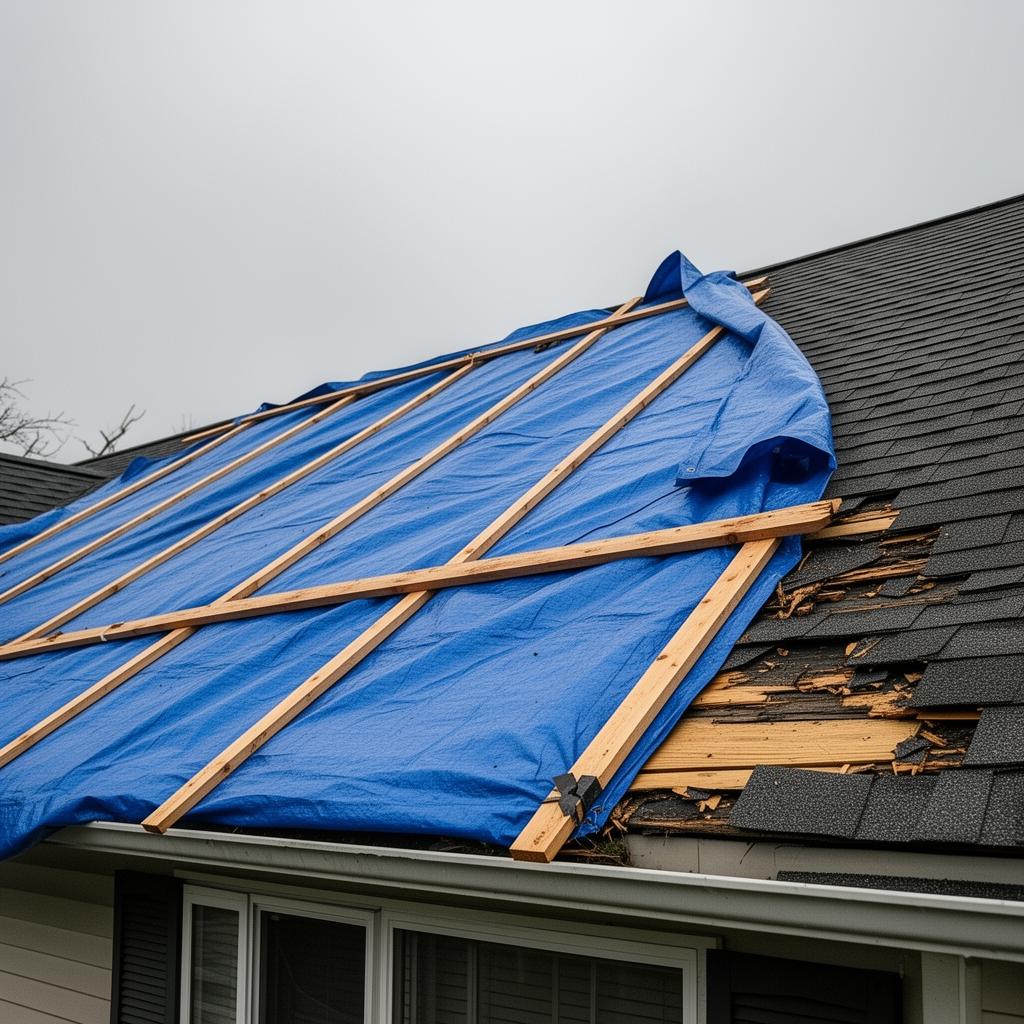
Tarping is a temporary fix. The goal is to keep water out until permanent repair can happen in safe weather.
Where the tarp goes: over the damaged area plus 3-4 feet of overlap on all sides. Anchored at the ridge with furring strips and cap nails. Edges weighted or strapped.
What tarping doesn't do: fix the leak permanently, prevent all water entry (a heavy sustained rain can still find weak spots), or look pretty.
How long a tarp lasts: 2-6 weeks safely. Beyond that, UV breaks down the material and the anchor points start failing. We schedule permanent repair within that window.
Tarping cost typically runs $200 to $500 depending on size and access difficulty. Permanent repair gets quoted separately.
Insurance Documentation
Storm-driven roof damage is often covered by homeowners insurance. We help by documenting everything in real time.
Photos: before tarping, during, and after. Wide shots and close-ups of the damage.
Written condition report: what we found, what we did, what permanent repair will require. Submitted within 48 hours of the emergency call.
Receipts: itemized invoice for the tarping work. Most insurance policies cover emergency mitigation expenses.
We don't negotiate the claim with your adjuster - that's regulated work in NJ. We provide documentation and answer the adjuster's questions. The Insurance Information Institute storm claim guide covers the homeowner side of the process.
What to Do Until We Arrive
Move stuff away from the leak. Electronics, paperwork, anything water-sensitive.
Bucket the drip. Multiple buckets if multiple drips.
Photograph the damage from inside (carefully) and outside (from the ground only - don't climb in a storm).
Don't climb the roof yourself. Wet shingles are slick. Wind during an active storm makes climbing genuinely dangerous.
Don't try to tarp it yourself. A poorly anchored tarp in wind becomes a sail and rips off (or rips other shingles off with it).
For the full emergency service overview, see our emergency roof repair page. For coverage in our home county, Ocean County storm response.
Related Posts
Roof Leak Repair in NJ - When to Call vs Wait
How to triage your leak before you call.
Read more →Roof Repair NJ - Cost & Timeline Guide
What permanent repair looks like after the tarp comes off.
Read more →Emergency Roof Tarping - When and Why It's Needed
The mechanics of emergency tarping after storm damage.
Read more →Free Inspection
Got a Storm Emergency? Call (732) 770-3867
Brick Township | Toms River | All four counties. We answer 24/7.